Showing posts with label Euro. Show all posts

Feb 25, 2012

Weekend Links


How many years has the economic crisis set back the most affected countries?

China's foreign exchange reserves move the Euro.

Is an engineering degree better than an MBA if you plan to start a company?

Marketing dollars vs. the time spent by consumers on different categories of media.

With more investors entering the market and less interest in homeownership, the US is seeing the number of homes rented increase.


Jan 27, 2012

The MF Global fallout and other links

  • I am surprised the markets shrugged off the MF Global loss of client funds so easily.  I am hopeful that the end result will be tighter restrictions to prevent such losses in the future.  Until this happens though I would have thought risk premiums might need to widen generally or a least some other brokers might suffer as customers gravitated towards the strongest.
  • A retrospective on housing market declines that looks at where Australia might be in that process.  Real estate still seems expensive in Australia and with China likely to be shoring up its economic growth this year, I don't think AUD interest rates will be adding price support to housing.
  • A study that looked back at asset backed securities and their ratings histories found that the securities included in CDOs later experienced worse ratings downgrades.   The conclusion implied that CDO sponsors were exploiting some kind of information advantage to skew the results that the buyers experienced.  This was the case even when controlling for yield which is where I would normally expect default expectations to be priced.  The authors looked at the entire asset-backed universe but CDOs were concentrated in the housing and commercial real estate sector.  I may have missed where the ABS sector was controlled for but if it was not controlled for I could see how warped investor demand for housing CDOs led to warped housing prices and ultimately very poor performance of housing ABS without needing asymmetric information between CDO sponsors and buyers.  I don't know what really happened of course, but the explanation from the authors seems like an elaborate and difficult application of exceptionally good ex-ante judgement.  Such good judgement is both valuable and rare so it is best applied with simpler strategies and fewer moving parts to depend on.


Jun 26, 2010

Weekly summary: Stopped out of gold short

I stopped out on the way back up through 1250 today.  It tested down through its 20 day average on Wednesday but didn't stay below for long.  There is some chance the bounce back was expiry related but gold continued higher after the expiration.  Any trapped longs from Monday's breakout have surely been stopped or replaced by stronger hands by now negating one of the drivers for the trade.

The gold rally might get tested in the near-term with the Eurozone fright having past and China resuming currency liberalisation.  I expected a bit more risk seeking this week as markets moved past the fears of a few weeks back but the results were pretty muddled.

  • Bonds are still pressing highs but momentum is ebbing.
  • Gold is similar with early weakness giving way to a weekly close near highs.
  • Equities are heavy but holding recent lows.  It is tough to gauge the impact of the US financial reform debate, with banks trading relatively heavy but wider market moves not reacting to the news flow on that topic.
  • the Australian dollar and Canadian dollar should benefit a lot from stabilising macro news.  Both got dumped more on liquidity than fundamentals when the Euro made lows.  The movements this week support the story that stability is returning but only weakly with movements being a bit lacklustre.  Action in the AUD may be slightly muddled by the Australian leadership change but the big news on that front is probably yet to come as the mining tax negotiations get underway.  


On the Eurozone fright, I don't think I had given enough weight to the idea the Germany could abandon the Euro.  The smaller size of the PIGS, and particularly Greece, made me quickly assume that either Greek debt would be written down or Greece would leave the union.  How can anyone benefit from a currency union where the strong members are encouraged to leave?  Anyway, with the Euro keeping gains and moving up through the week my view may be becoming more mainstream.

On China, it seems like the world is still debating whether the announcement last weekend really means anything (or this).  China is in an odd spot of wanting to dip a toe in with gradual currency movements but knowing that once its intentions clear the market will front run the policy.  This makes timing difficult but ultimately it all appears to be heading toward a stronger yuan and stronger Chinese consumption.  This may uncover some domestic imbalances as it goes forward but near term this also points towards stability.

I also wonder if the traders aren't a bit too negative on the G20.  The view seems to be that either there is nothing to talk about or talks might degenerate into an ugly round of finger pointing.  I expect politicians will err on the side of vague positive statements and keeping disagreements out of the public eye.  Even acknowledging that the world can not return to the pre-2008 configuration of trade and capital flows might be viewed as above expectations.

May 30, 2010

Long-term perspective on currencies and central bank policies

I was doing some house cleaning, tagging old entries and came across something I wrote in 2005 on central bank policies:
On a related note, foreign CBs will not turn net sellers of dollar assets. They will stop adding to USD reserves which still creates a substantial problem for U.S. interest rates. The markets will continue testing the CBs' appetite for dollars until we see real policy changes and a market determined equilibrium.
This referred to the US dollar but the underlying logic still applies to this week's scare regarding China turning seller of Euro assets.  China has deep pockets and very little interest in adding to currency instability.  The status quo (Yuan pegged at sub-market rates to stimulate Chinese exports) has done well by them and while it can't go on forever now would be a shockingly poor time for a drastic change.  Why would they do this in the midst of speculative fervor to short the Euro and a general panic regarding European assets?

My 2005 self went on to make the following predictions:

There will be some sort of market event with the most likely candidates being housing and interest rates.
This market event will ultimately require international cooperation (G7, G10). It may take a series of trials (maybe a series of crises) by various CBs and governments but eventually they will need to coordinate policy. The world will need to decide how to handle the issue of the weakening dollar as its main reserve currency.
On a related note, foreign CBs will not turn net sellers of dollar assets. They will stop adding to USD reserves which still creates a substantial problem for U.S. interest rates. The markets will continue testing the CBs' appetite for dollars until we see real policy changes and a market determined equilibrium.
Unemployment seems like the best indicator of how hard or soft the landing is in the real economy. Below the June '03 high of 6.3% seems like a good definition of a soft landing for the U.S.[The main question being discussed was whether the US was whether the Fed hiking cycle was leading up to a soft landing.]
The U.S. current account deficit will get worked off through the growth of emerging market consumption rather than U.S. economic contraction. These emerging economies are the logical target for the world's investment dollars so once the market regains control of capital distribution they should see some benefits.
While this was a useful high level map, in the end it mostly helped me to avoid risks.  The policy coordination I expected has yet to materialise and instead it is a dog eat dog world of competitive currency devaluations.  This makes a fertile (read volatility swings) ground for trading, especially in currencies.  I expect this will continue until central bank coordination occurs enabling debt-heavy importing countries to start paying off their creditors.
Enhanced by Zemanta

May 19, 2010

Are German naked short and CDS bans really that awful?

In response to the German bans on some naked short-selling and naked credit default swap (CDS) purchases Zero hedge declares:
If this pans out as expected, look for Bunds to collapse tomorrow, and wipe out a few billion from Pimco's NAV. We warned in February that the flight to safety in Bunds was both shortsighted, and too good to last.
I disagree.  Banning naked short selling and unmatched CDS purchases are fairly mundane regulatory changes.  Shorting is still allowed as long as the bonds or shares can be borrowed and default swaps are still available but only for hedging purposes.  Coming so soon after the bailout announcement, this is being linked to the "wolf pack" behavior mentioned by officials last week but these policies are in line with reform recommendations from before the Greek crisis made it to the front burner.

This may be the sort of news that can set off a panic given the view by many that the Europeans are flailing about but I expect the real money will take note of the limited scope and difficult enforcement of today's bans.  While I agree that Europe has not yet come to terms with Greece as a solvency problem rather than a liquidity problem, the current approach is still printing Euros to pay bond holders, so the downward pressure should stay focused firmly on the Euro.

With the lopsided view and large short positions in the Euro currently, I am not even sure the one way trip down there can continue through tomorrow.

May 8, 2010

Stock market stunned by its own fragility

The price action this week in equities was a change of pace.

Volatility Chart

I included the chart above to show just how low the short term volatility of SPY had fallen before the recent pull back.  As much as much as the Greek debacle may be the proximate cause of the stock drop, the steady grind higher over the last two months had left the market ripe for a pull back. The price drop is severe enough that momentum traders will be throwing out positions while value investors will still be on the sidelines for a few hundred more S&P points.  

US stocks continued lower on Friday, but the long bond and the Euro changed direction.  The long bond has been on a strong two week run up that was goosed higher by yesterday's late afternoon panic, while the Euro had been weakening in response to Europe's sovereign debt woes. Both trends are stretched but seem well supported by the current fundamentals.  The reversals in these markets, though mild, makes me think equities will not start next week in free fall.

The Greek saga (which began in early December 2009) dominated the headlines with European policy as of last weekend looking to keep the monetary union intact at the cost of a steadily weakening Euro.   There is still a lot of skepticism whether the current bailout for Greece is enough and whether the same thing can be done for the other PIIGS but it seems to me that where there's a will there's a way.   This is the train of thought that is driving the weakening Euro.  It may still happen that Greece abandons the Euro (likely leading to a sharp recovery in the currency) but I think the policy response of last weekend postpones it by a year while the powers that be wait to see if the austerity package works its magic.

A Greek debt restructuring will also relieve some pressure on the Euro and provide a far better template for the other PIIGS (should their situations worsen) to follow.  For all the weekly on again off again bailout announcements regarding Greece it is still not clear the authorities have done their homework and come up with a plan for the Euro and European debt markets that won't need to be reevaluated in the near future.  This lack of credible long term goals is the key uncertainty spooking the markets.  This thought from 2004 still reflects my view on why attempts to use the bailout package to discipline the Greek government is misguided.  

Most of the economic news out of the US has been positive, though ignored.  It was capped off today by  the best jobs report in years.  The positive recent news is being ignored due to fears of slowing growth in the second half of the year. As the US fiscal package winds down there is no obvious candidate to replace it.

Jun 14, 2005

European Interest Rates

From the FT:
Hints by Jean-Claude Trichet, ECB president, and Otmar Issing, the bank's chief economist, that the possibility had increased of borrowing costs falling have contrasted with comments by several national central bank governors on the committee.
The differences highlight the dilemma faced by the ECB. Economic growth, lacklustre for the past four years, has slowed again, and politicians are increasing the pressure for a further cut in borrowing costs. But excess liquidity and oil price increases are sounding inflationary alarm bells.
The confusion puts pressure on the ECB to clarify its stance at its next rate setting meeting on July 7.
I wrote last week that I doubt U.S. interest rates will plunge like Japanese rates did in the 90's. I am much less convinced that the same can be said for Europe. The U.S. is in a much more attractive position to prevent deflation because lowering U.S. interest rates mostly punishes foreign lenders. Europe's higher savings rates make the ECB's decision tougher. In the end I think they will cut rates (maybe this fall) and I am guessing it will happen while the euro is rising rather than falling. I would also expect the ECB to follow any rate cuts by the U.S. Fed this time around too.
Enhanced by Zemanta

Jun 10, 2005

China's Peg Planning

From the NYT:
China's political leadership is actively considering breaking the 11-year link between the dollar and China's currency, the yuan, and tying its value instead to a group of currencies, current and former senior Chinese officials said in interviews. The proposal being weighed at almost daily meetings of the Standing Committee of the Chinese Communist Party's Politburo would use a so-called basket of currencies to set the yuan's value. The yuan would move up and down in currency markets in relation to the average values of the dollar, yen, euro and possibly other currencies like the British pound.

But the initial value of the yuan under the new system could, in dollar terms, be very close to its current value of 8.277 to the dollar.
...
The Politburo's Standing Committee - which includes President Hu Jintao, Prime Minister Wen Jiabao and seven other top officials - has made no decision yet on when or whether to act, and may decide soon or wait as long as next year, the officials said. But the deliberations have taken on a pressing quality, with the Standing Committee meeting almost every day last week to review currency policy. Senior economic officials have been told to be on hand for consultations at any moment.
In a telling instance, Yang Weizhe, the mother of Zhou Xiaochuan, the governor of the Chinese central bank, died at 6:30 a.m. on May 31, but Mr. Zhou was still required to attend a Standing Committee meeting on the currency an hour and a half later.

...

Victor Fung, a Hong Kong tycoon who is chairman of one of the world's largest garment companies and heads the territory's airport authority, said, "They recognize the need to go away from a peg and move toward a basket."
Mr. Fung said each currency's percentage in the basket should match the percentage of China's trade conducted in that currency, an approach favored by many economists. He also said that China should reveal the relative weightings of the currencies in the basket.
But other advisers said Chinese officials were leaning strongly toward switching to a basket without disclosing the currency weightings. Singapore has long done this with its dollar.
A few weeks ago speculative pressures were the reason for not moving. The current sentiment (knowing it is coming but it will be small and hard to time) is probably the best Chinese politicians can hope for.

They sure seem to be focusing on the finer details right now. In currencies I have quite a few yen longs on and most recently shorted AUD/JPY near here (stop at 83.5). That chart is bouncing along just on top of a long uptrend and looks set to have a big reaction to any yen strength. Other than oil, the commodity stocks have not put in much of a recovery so I am also watching the AUD to see if it is pointing out continued weakness there.

May 12, 2005

Evaluating USD Strength

While the dollar is showing some strength on the smaller than expected trade deficit, I am not convinced it means a whole lot. I still tend to view Asia vs. Europe as the better risk trade but the U.S. is not fixing any of its longer term problems, so it will probably resume its downtrend eventually. The new budget (mentioned here via Brad Setser and here via Mark Thoma) is just adding to capital account needs and over time the trade numbers will reflect these policy mistakes.

Bill Cara explores the dollar's overnight strength and concludes with this:

I say that if the Bank of China does not revalue the Renminbi yuan this weekend, which is a longshot at best, there will be serious hedge fund failures next week. That's because traders like me are massively short the dollar and will have to close those positions.

Financial Armageddon just could be at hand, and we all were looking at the GM equity-bond trade issues as the biggest problem for some hedge funds when we should have been looking at the Dollar.

Traders cover losing bets all the time but hedge fund failures are a bit more infrequent. It is certainly in the air this week but with JPY below 136 to the EUR I am not sure people are that stressed. Below is a EUR/JPY chart with 4 hour bars.

Click on the chart to see a larger image!!
Posted by Hello

That seems like where the renminbi revaluation expectations have been most pronounced and probably where their is the most risk of a snapback. Greenspan's speech swung some weight behind the idea that China was facing internal pressures to revalue and that is a very persuasive argument for macro funds. The U.S. trade deficit doesn't seem like much of a catalyst in the trade. More of a distraction.

May 6, 2005

Summing Up the Week

We end the week weighing the auto downgrades and steepening yield curve (new 30-yr) against an unexpectedly positive jobs report and Kerkorian's bold bottom fishing maneuver in General Motors (GM).

On the auto downgrades it seems very likely that the bond market had already anticipated the downgrade. Its arrival shifts the focus off of the auto bonds and towards the wider bond market. I would not be surprised if GM and F bonds bottom here or shortly while junk spreads continue to widen. A best case would be junk widening while investment grade tightens but I would guess such a trend would be short lived. I am not really sure where Kerkorian's bid fits into this picture other than to muddy the waters. It is not clear what his motivations are and I am not sure that GM's equity is the best risk / reward trade in here.

I said any investment grade tightening might be short lived because the jobs report and new 30-yr created a lot of uncertainty in the long end of the yield curve. On Tuesday I thought the market would start to anticipate an end to the hiking cycle but this jobs report brings us back to considering 50 bp hikes. Easy to see why it was important for the Fed to reinsert a benign long-term inflation outlook. Anyway, the jobs report is just one data point and it needs confirmation in the rest of the data this month as well as next month's report. People were all about the "soft patch" at the beginning of the week so this report should cause a serious reexamination.

At some point between now and August the market will probably have serious doubts as to whether the 30-yr actually comes back. There are also supply constraints until the new bond is a sure thing so if the shorts get too heavy while it is only an idea that could set up quite a squeeze. A decision in August seems to put the new 30's issuance in Nov or Feb.

All this U.S. news has managed to crowd the yuan revaluation out of the news. Asian currencies are still trading strong though. Even though China does not want to reward speculators, the pressure internally are only going to get worse until they revalue. I thought they were coming to grips with that but maybe it takes another couple of months. They would need some help from Japan or Korea to scare the speculators at this point and I don't see much of a cause for that. The dollar also rallied nicely on the back of the jobs data but the theme to me is still European weakness. Gold and silver are focused on USD/EUR rather than JPY/USD. I am not sure why that is.

Mar 9, 2005

Yields Resume Trend

The new highs in the 5-yr yield yesterday confirm my view of the jobs report. The Fed sees rates as accommodative and is worried that commodity inflation (PPI) could eventually move the CPI. The economy is not very strong though which could lead to political pressure to choose inflation over unemployment. That jobs number confirmed economic weakness while still putting up a strong headline number for employment growth. That leaves us with accommodative rates, commodity inflation and no pressure to keep rates low.

Stocks are tough to call here. They may be a safe haven against inflation and can lag interest rate moves by months. I tend to think they will have a negative short-term reaction to higher yields but we now have lots of support from last year's highs and this year's lows nearby.

The ECB is making some tough talk about inflation but I still see their next move as a liquidity increase to bring the Euro down. I have thought that for over a year.

Feb 4, 2005

Yeah But...

The tape is gliding higher and lots of momentum patterns are managing to add to gains. Something does not feel quite right to me though. Maybe the market is just experiencing anxiety over the bad jobs report but there does not seem to be a great deal of volume associated with the price climbs. Take a look at Intel (INTC) for example. Anemic. Also, I am not noticing many new stocks breaking bases to create the next wave of advancers. I am trying to sit on my hands here and just roll up stops.

One more thought, if the jobs numbers created a deflation scare wouldn't the Euro appreciate like crazy? Unlike the U.S. and Japan, the ECB has been unwilling to print currency in an effort to spur growth so I am not sure how deflation makes the Euro weaken.

I gave my little tirade about the slack jobs market this AM but this guy really digs into the numbers. And while I am back on the subject, today's labor report seemed pretty much in line with other recent reports so in my view it was really the distortion of expectations that stands out. Maybe we get a reflex action the other way next month with predictions well below the announced number.

Feb 2, 2005

Currencies Wind Up

$/Yen is flirting with a break out of the medium-term pennant I drew a while back. The Euro has also coiled into a pretty tight range against the USD. I have no intention of doing anything before the Fed and will probably wait until tomorrow morning to avoid head fakes. My guess is that tomorrow morning you will want to go with whatever move has started.

This ties in pretty well with what yesterday's thoughts that the bond market may get a bit of an awakening. Whether that is the case or not, the kind of move I expect should last several weeks so trying to anticipate it makes little sense.

Jan 17, 2005

Currency Swings

Both the Won and the Yen did alright in last night's market.

The won's 0.7 percent fall against the yen this year has already made Korean products cheaper abroad relative to those of its Japanese rivals. Yesterday, the yen advanced to 101.70 per dollar, the highest since January 2000. Other Asian currencies strengthened after the yen's rise.

The won climbed 0.7 percent to 1,035.70 won to the dollar, its highest close since December 31.

The article I pulled that from has a nice summary of where those currencies stand. Maybe they will reverse off highs like the Euro did but I don't think so.

Dec 1, 2004

Dollar Woes

Both the Pound and the Euro are making higher highs against the dollar now. Not the most trustworthy of moves as it is happening after New York close and before Tokyo open but still probably not a good thing.

With the renewed strength in equities and the drop in oil it is probably a sign that we have finished a countertrend period for markets. While the dollar did not get a bounce, accelerating weakness would confirm that idea. Could lead to strength in metals tomorrow.

Nov 23, 2004

Dollar bounce

The dollar is getting a good bounce in Asia. The yen has recovered the 103.42 level and the Euro is leaning on 1.30. I would say the recent lows make a nice stop loss.

If the dollar and the stock market continue their link this will weigh on stock tomorrow. Of course the dollar has to keep its gains. We shall see.

Nov 19, 2004

Morning reversals

U.S. 10-yr yields, the Euro and GBP have all reversed in the early morning while the Yen continues making new lows (stronger) below 103.42. Call me crazy but I say the Yen will reverse today too. Not a good trade because it does not have a floor but taking profits here makes good sense.

Oct 23, 2004

Really the bottom? (DXY, SPX)


Posted by Hello

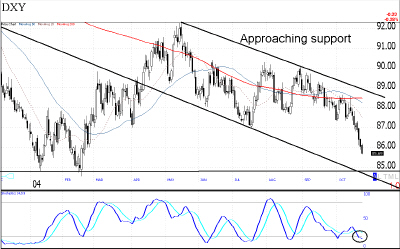
The DXY (Dollar Index) is oversold and coming into double support around 85 from the downtrend line and the '04 lows. Hard to see it bouncing past the 87-88 level and probably a good short when it arrives there. The longer-term downtrend has almost certainly resumed for the reasons given here and I continue to think the Euro and the Yen are better longs than the Pound and commonwealth currencies.


Posted by Hello

This is important because while the Dow appears in freefall toward the bottom of its channel the S&P does not look nearly as bad. This oscillator in particular shows that instead of gaining downside participants the market is losing momentum. A bounce above 1110 in the S&P without a new low for the oscillator would confirm a short-term bottom. Here is an explanation of the oscillator for those unfamiliar with it.

Definition from TC2000 - "The McClellan Oscillator is calculated by subtracting a 39 day moving average of (Advances – Declines) from a 19 day moving average of (Advances – Declines). It not only works as an overbought/oversold indicator, it works fairly well at making short-term trend changes when it crosses the zero line."