I imagine we are making near term highs in the equity markets. Maybe slightly above here over the next 4 days and then a pullback. Maybe to 36.20 in the QQQQ. I am chucking out some of my longs with plans to kick the rest out tomorrow. Maybe we are into a topping process that leads to some good long term shorts but I would say it takes a couple of weeks and will be staying flat on equities and watching.
I am going to start building a long bond short in here. Going to go slow as it seems like the dollar might need to top out to create any real weakness.
I don't see this mornings inflation number as a problem and generally just see it lagging the PPI top. I don't see how that top can get taken out without a massive reversal in commodities. Those charts are disaster zones and probably need to base for 2 months. If I am wrong and that rally relaunches I would reconsider my view that inflation fears peaked in March and are headed lower.
May 18, 2005
Auto Supplier Bankruptcy
My brother works as an engineer at an autoparts supplier and he asked me if he should buy some shares in Collins & Aikman, which filed for chapter 11, yesterday while it trades around $0.10. I replied that he has plenty of risk on the books just by working in the industry and that the action will be in bonds once the stock price is below a buck.
The company has some 2011 bonds that are trading near $0.40 at a roughly 35% yield. It may have overshot in the short-run but at those levels there is not much hope for the stock. I mentioned investinginbonds.com as a source for corporate bond prices the other week and while it is not a very good market for individual investors the prices can give some insight into a company's prospects. Definitely worth checking out before playing in the equity.
The company has some 2011 bonds that are trading near $0.40 at a roughly 35% yield. It may have overshot in the short-run but at those levels there is not much hope for the stock. I mentioned investinginbonds.com as a source for corporate bond prices the other week and while it is not a very good market for individual investors the prices can give some insight into a company's prospects. Definitely worth checking out before playing in the equity.
 Tags:
Bonds
Tags:
Bonds
May 16, 2005
Norway Sells Half its U.S. Treasury Bonds
From Reuters:
Today's news continues the trend of taking some pretty surpising data in stride. In the last two weeks we have gotten over strong employment data (too construction heavy), a shrinking trade deficit (it was Chinese New Year), and strong retail sales (screwed up by Easter). My answer to all this is that the market is just not focused on the data. It probably doesn't help that there has been a pretty mixed picture.
I kind of feel the path of least resistance for the markets is higher (lower for UST bonds) as lots of people seem to be looking at long-term problems to drive current prices. This is most noticable in housing but so far there is little sign that market can't stay strong through the fall.
A surprisingly small flow of foreign money to the United States in March was due mainly to a halving of oil-rich Norway's U.S. Treasury bond holdings, raising questions about whether overseas governments are cutting huge holdings of U.S. assets.This was an interesting take on some pretty widely covered news. As Brad Setser says, "...Norway is not likely to sell $17 billion of Treasuries every month." Even so I am surprised the euro didn't get a little more mojo back against the dollar.A U.S. Treasury report on Monday showed the net flow of foreign investment to U.S. securities at $45.7 billion in March -- more than $20 billion below expectations and less than needed to cover the $55 billion U.S. trade deficit that month.
Foreign official institutions, consisting mainly of foreign central banks, were net sellers to the tune of $14.98 billion.
Close examination of the data shows these sales were dominated by Norway's more than halving its holdings of Treasury bonds to $16.9 billion from $33.8 billion.
Analysts said Norway's holdings are most likely those of the $160 billion Government Petroleum Fund, a fund of foreign stocks and bonds set up in 1996 aimed at saving oil and gas revenues for the future, when energy resources run out.
...
Norway's Treasuries holdings rose by more than $20 billion in the second half of 2004 to $35.1 billion in January, said Goldman Sachs economist Thomas Stolper. He added that March looked consistent with a very active investment stance.
Today's news continues the trend of taking some pretty surpising data in stride. In the last two weeks we have gotten over strong employment data (too construction heavy), a shrinking trade deficit (it was Chinese New Year), and strong retail sales (screwed up by Easter). My answer to all this is that the market is just not focused on the data. It probably doesn't help that there has been a pretty mixed picture.
I kind of feel the path of least resistance for the markets is higher (lower for UST bonds) as lots of people seem to be looking at long-term problems to drive current prices. This is most noticable in housing but so far there is little sign that market can't stay strong through the fall.
Tags:
Bonds
May 14, 2005
Hedge Funds vs. Day Traders
From The Guardian:
The herding instincts of investors are truly remarkable. Similar beasts stick together, chasing the same stocks at the same time and often risking great financial peril, but such instincts can also overwhelm very different investor species. In recent times the grandest of hedge fund managers have found themselves thundering shoulder to shoulder with the scruffiest day traders ... towards oblivion.The article makes some interesting comparisons but its probably a little over the top. Entertaining reading though.
May 13, 2005
Volatily Spiking Again
The scariest part of today's action has to be the spike in the VIX back near 18. The VIX bounced its way down to the 12 level over the course of 2 years and this quick move up is going to cause a lot of pain for options sellers. Besides that the higher vol will require options hedgers to sell increasingly larger size into the market as it heads lower. Implied and actual vols are also used pretty heavily to measure the risk on trading books so this move really has the potential to pull liquidity from the market.
As I mentioned all the talk of hedge fund trouble this week I was a bit skeptical. A rising VIX makes me a lot less skeptical.
As I mentioned all the talk of hedge fund trouble this week I was a bit skeptical. A rising VIX makes me a lot less skeptical.
Tags:
volatility
Confusion
The data and market reactions over the last couple of days have left me pretty confused. I am focused on the commodity weakness. In March the reason for Fed tightening was the inflation coming through the system and made obvious by the highs being hit in the CRB, oil, copper, steel and too a lesser extent houses. Now the commodity sector has backed off considerably. This could be viewed as evidence that growth is slowing in Asia. It should reduce the need for Fed tightening.
Ditto for the widening of corporate spreads. It was a sign of excess liquidity but now the rising risk premiums have taken that argument off of the table.
The dollar strength evident yesterday should also give the Fed more options.
Throw in a couple of good data points on the economy and the thought that securities markets could be distorted in here by hedge fund troubles and I am having a tough time knowing what to think.
Ditto for the widening of corporate spreads. It was a sign of excess liquidity but now the rising risk premiums have taken that argument off of the table.
The dollar strength evident yesterday should also give the Fed more options.
Throw in a couple of good data points on the economy and the thought that securities markets could be distorted in here by hedge fund troubles and I am having a tough time knowing what to think.
May 12, 2005
Evaluating USD Strength
While the dollar is showing some strength on the smaller than expected trade deficit, I am not convinced it means a whole lot. I still tend to view Asia vs. Europe as the better risk trade but the U.S. is not fixing any of its longer term problems, so it will probably resume its downtrend eventually. The new budget (mentioned here via Brad Setser and here via Mark Thoma) is just adding to capital account needs and over time the trade numbers will reflect these policy mistakes.
Bill Cara explores the dollar's overnight strength and concludes with this:
Click on the chart to see a larger image!!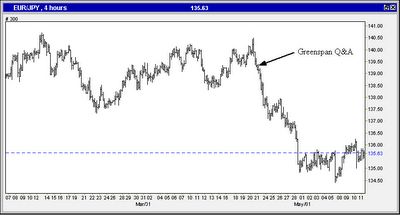
Posted by Hello
Bill Cara explores the dollar's overnight strength and concludes with this:
I say that if the Bank of China does not revalue the Renminbi yuan this weekend, which is a longshot at best, there will be serious hedge fund failures next week. That's because traders like me are massively short the dollar and will have to close those positions.
Financial Armageddon just could be at hand, and we all were looking at the GM equity-bond trade issues as the biggest problem for some hedge funds when we should have been looking at the Dollar.
Traders cover losing bets all the time but hedge fund failures are a bit more infrequent. It is certainly in the air this week but with JPY below 136 to the EUR I am not sure people are that stressed. Below is a EUR/JPY chart with 4 hour bars.

Posted by Hello
That seems like where the renminbi revaluation expectations have been most pronounced and probably where their is the most risk of a snapback. Greenspan's speech swung some weight behind the idea that China was facing internal pressures to revalue and that is a very persuasive argument for macro funds. The U.S. trade deficit doesn't seem like much of a catalyst in the trade. More of a distraction.
Tags:
Euro,
Japanese Yen
Explaining the Hedge Fund Rumors
From the FT ($$):
When considering trades like this it never hurts to just look at being naked long the riskiest portion in much smaller size (targeting an equal return). Usually when the trade goes bad the variance in the bid/offer spread has been grossly underestimated. Its possible that an unhedeged position might get the same yield with about 1/20th the notional value so if things go bad it's easier to dump it rather than hang on waiting for the bid/ask to tighten back to normal.
I have never traded the CDO market and am just assuming that like most derivatives the bid/offer is several times wider than on the underlying. When the underlying is a corporate bond that is a lot of hay just to break even on a spread trade.
There is a saying (mostly in currency markets) that goes "the road to hell is paved with positive carry." That people would have this kind of trade on and lose money doesn't really surprise me. That anyone would have it on in big enough size to risk their solvency would.According to Mike Harris, credit derivative strategist at JP Morgan, hedge funds had been putting on a trade which involved buying the equity tranches (the most risky) and going short (gambling on a decline) in less risky mezzanine tranches. They leveraged up this trade by selling protection (options) against the equity portion. That trade gave investors a positive carry since the yields on the riskiest tranche were higher than the yields on lower tranches.
But the emergence of idiosyncratic risk in the form of the downgrades at General Motors and Ford has caused the spread on the equity tranches to widen, causing losses for the hedge funds putting on this trade. As they attempted to unwind their positions, the selling pressure pushed prices down even further.
When considering trades like this it never hurts to just look at being naked long the riskiest portion in much smaller size (targeting an equal return). Usually when the trade goes bad the variance in the bid/offer spread has been grossly underestimated. Its possible that an unhedeged position might get the same yield with about 1/20th the notional value so if things go bad it's easier to dump it rather than hang on waiting for the bid/ask to tighten back to normal.
I have never traded the CDO market and am just assuming that like most derivatives the bid/offer is several times wider than on the underlying. When the underlying is a corporate bond that is a lot of hay just to break even on a spread trade.
May 11, 2005
Savings Glut or Investment Dearth?
I have been waiting patiently for Billmon at Whiskey Bar to post his 3rd entry on this issue. His first 2 pieces (Part I and Part II) were excellent and I highly recommend them to anyone who did not run across them already.
You'll probably want to read Nouriel Roubini's latest piece first as it is referred to at several points. It also provides context for the savings debate within a bigger economic picture.
Here is a taste of what Billmon says:
You'll probably want to read Nouriel Roubini's latest piece first as it is referred to at several points. It also provides context for the savings debate within a bigger economic picture.
Here is a taste of what Billmon says:
I will probably be back when the series raps up with some thoughts. Until then I am keeping an open mind. This issue is extremely important though and perhaps even urgent. It seems like the next 6 months will see a short-term test of the "savings glut" thesis (a liquidity crisis). How that test works out just depends on where the long-term equilibrium actually is.Instead, the problem appears to be a variation on the same theme Keynes explored 70 years ago: Private individuals with savings to lend are holding out for a higher price (interest rate) than borrowers are willing to pay - and in America's case, probably higher than it could afford to pay, given the quantity demanded.
By afford, I don't mean America is literally too poor to cover the vig, but rather that the interest rate required to finance the current account deficit solely from private sources would slow the U.S. economy and short circuit the current investment recovery - thus drastically reducing, if not eliminating, the demand for foreign savings.
This state of affairs has forced the ODIC governments to step into the breach and provide the financing that private lenders are no longer willing to offer. In effect, they are forcing the savings-investment market to clear - at an artificially low price. We can assume they are not doing this out of the goodness of their hearts or because of the kindness of strangers. They are propping up the market because they, too, are afraid of the deflationary wolf and so far haven't figured out another way to generate the kind of growth rates they need to stay one step ahead of it.
What makes all this such an interesting variation on the old Keynesian theme is that the recalcitrant lenders and the increasingly strapped borrowers happen to live in different countries with different currencies and different central banks - as well as different cultures, ideologies and geopolitical objectives, some of which may not be reconcilable.
Tags:
Savings rates
Hedge Fund Follow-up
These two articles show opposite side of yesterday's fears.
First from Bloomberg:
First from Bloomberg:
``It's more rumors than fact,'' said Brett Barth, a partner at BBR Partners LLC in New York, which invests in hedge funds for its clients. ``There are a handful of trades not working, so people are worried that there are hedge funds being forced to liquidate their holdings to meet redemptions.''Next the NYT:
I still have a hard time seeing the correlations between assets as high enough to prevent new money from flowing into disrupted areas. Not doing anything on the news but watching.Another large hedge fund manager, GLG Partners, which is based in London and is 20 percent owned by Lehman Brothers, had losses ranging from 2.5 percent to more than 8 percent as of last month on some of the portfolios it manages, according to a person briefed on the results. Officials at GLG did not return e-mail messages sent to their offices yesterday afternoon. A spokeswoman for Lehman declined to comment.
Yesterday's sell-off began on European markets amid a rumor that Deutsche Bank stood to suffer losses because of its exposure to a hedge fund that was caught wrong-footed by the recent cut in the credit rating of G.M.'s debt. Shares of Deutsche Bank fell 3 percent.
Subscribe to:
Posts (Atom)